
Tackle

Westcountry Rivers Trust

Submitted by admin on December 8, 2008 - 3:57pm

Looking after the river and your interests
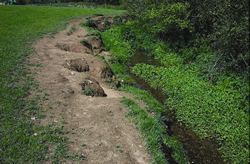
The Westcountry Rivers Trust is an environmentally charity established in 1995 to secure the preservation, protection, development and improvement of rivers, streams and watercourses in the Westcountry and to advance the education of the public in the management of water.

The Trust’s vision is to have living, working landscapes that deliver employment, food and amenity without impacting on rivers and biodiversity and without the need for heavy regulation and supervision.

The trust is one of the most active conservation organisations in the country. The greatest part of our work to date has been farm management advice targeted to reduce agricultural pollution, work which is not within the remit of any of our statutory agencies. To achieve this goal we undertake catchment scale projects, which are designed to foster environmentally sensitive farming, driven by financial savings in farming systems. To date we have worked in nearly 20 Westcountry catchments achieving almost complete coverage of all agricultural land within the catchments and we have worked with farmers to solve many problems contributing to diffuse pollution. The headline achievements from these projects are as follows:

  • 1800+ farmers & landowners given advice
  • 1380+ Integrated Land & River Management Plans
  • Over 95,000 ha of land targeted with management advice
  • 235 km+ vulnerable riverbank fenced
  • 16 wetlands restored/improved
  • 85+ km ditches prioritised for re-vegetation
  • 350+ sites of accelerated erosion controlled
  • 35 demonstration sites developed and operational
  • 270+ sites of habitat improvement
  • 50+ buffer zones created

Trust staff are also delivering advice on the new Cross Compliance rules which farmers must observe to receive their single farm payment. The rules are complex and the Trust is helping farmers to interpret them to achieve the best outcome for their business and the environment. Trust staff also give advice on accessing the new agri-environment payments called ‘Entry Level Scheme’ and ‘Higher Level Scheme’. By committing to one of these schemes farmers agree to decrease some areas of productivity and alter some practices for environmental benefit. The Trust assists in this wherever possible and we try to ensure rivers and the water resource feature highly in everyone’s priorities.

The Trust also has a hard working education team. In 2006 the Team are pushing forward with primary and secondary school visits and with the teaching of the Trusts newly accredited foundation degree, based at Duchy College. The first year students on the degree course are progressing well and are currently being put through their paces on ‘good soil management practices’. This is just one of the elements making up the degree course in Sustainable River Basin Management. We hope that the students graduating will be tailor made to fit new opportunities presented by the Water Framework Directive. This directive is designed to deliver joined up thinking on water resource protection and the Trust is again at the forefront of its implementation.

The Trust also has a thriving Fisheries function with a very active research arm. Much of the research is based at Exeter University and is largely concerned with salmonid ecology. This work has expanded in recent years to the extent that we are now recognised, jointly with Exeter University, as a leading fisheries research institution. We are asked to provide opinions at the highest level on issues of fisheries management in the UK and internationally. The fisheries team, in collaboration with Kings College London, are also leading the way nationally, investigating the causes for the huge declines in European eel numbers. Trust staff have set up eel traps on rivers and are recording the size age, sex and parasite load of eels entering and leaving rivers. This should lead to a better understanding of precisely which life stage of the eel appears to be under pressure. An international eel symposium is to be held by the Trust in collaboration with the national Association of Rivers Trusts at London Zoo in April 2006.
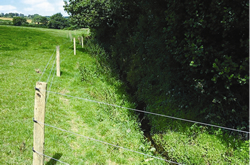
These lofty undertakings may not, at first sight, seem relevant to the Westcountry but the causes of these problems are often found far away and it is part of the Trusts ethos to tackle problems at their source rather than trying to manage the symptoms.

The fisheries team also deliver lots of on-the-ground practical work to restore rivers and currently we have funding to focus effort on the Little Exe, which has seen declines in salmon juvenile numbers. Practical work will also be carried out on many other Westcountry rivers over the summer.

In addition to this 2006 will see another successful rollout of the Trusts Angling 2000 day ticket scheme. The Scheme was a stroke of genius dreamt up by Dr Simon Evans, the Trusts former head of fisheries. Simon found many miles of very good but under utilised fishing during his routine visits to farms around the Westcountry. The Trust approached the owners of the fishing and offered a free advisory visit and a marketing service for the fishery. The scheme has since gone from strength to strength and day tickets for all the beats in Devon and Cornwall can be bought online, by mail or from the office. The beauty of the scheme is that profits go straight back to the owner and the owner, in-turn looks after the river which is the net beneficiary. The scheme is now available on the rivers Wye and Eden and tickets are interchangeable between schemes. The Wild Trout Trust also sells tickets. The scheme offers truly wild fishing on banks seldom trod and is a must for any really spiritual angler who hankers after a wild experience.

As you can, see the Trust works hard on many fronts to achieve its vision. The Trust can, however, only operate with the help of its supporters and the trusts work is only relevant if it represents the needs and aspirations of its supporters. With this in mind we hope to communicate with you as regularly as we can about our work. We hope that in turn you will guide us to address your concerns and that you will direct others with similar concerns to our door so that they can become a supporter and help the Trust in pursuit of its vision.

Contact details for the Trust:

Dr Dylan Bright CBiol MIBiol

Director

Westcountry Rivers Trust, 10, Exeter Street, Launceston, Cornwall PL15 9EQ

Tel: + 44 (0) 870 774 06 91

[email protected]

Contact details for Angling 2000:

www.angling2000.org.uk

Toby Russell CEnv MIFM

Westcountry Rivers Trust, 10, Exeter Street, Launceston, Cornwall PL15 9EQ

Tel: + 44 (0) 870 774 06 96

[email protected]

Or visit the Trust website at:

www.wrt.org.uk

Westcountry Salmon Tactics

Submitted by admin on December 8, 2008 - 3:57pm

Salmon fishing in the westcountry is like no other place on earth. Many river valleys that have evolved over millions of years descend from the highest of Tors across the moors toward the Atlantic and the English Channel, each cutting deep scars through the hidden countryside and providing some of the most rugged yet the most enchanting fishing one can imagine. Others flow unhurriedly through lowland farmland that by their nature produce a much richer flora and fauna than can be found anywhere in England.
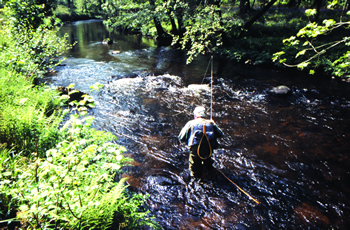
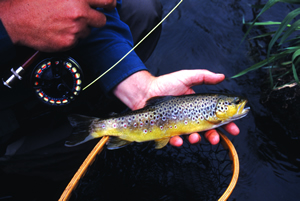
From the Avon to the Fowey, Torridge to the Tamar, many of the rivers of the westcountry boast a significant run of salmon during their season, making it possible to fish for the king of fish during almost every month of the calendar year. There are lots of hotels, clubs and association waters that can be found throughout this book, all offering excellent fishing and all at a reasonable price. Many offer the opportunity of fishing a variety of methods, including fly-fishing, spinning, and bait fishing.

Take to the Hills

Submitted by admin on December 8, 2008 - 3:57pm

Spectacular scenery, miles of fishing to explore, hard-fighting wild brown trout, and a price tag that doesn't require a second mortgage - that is moorland trout fishing and here in the South West there is plenty to choose from. Head for the Dartmoor and Exmoor National Parks and you will find miles of sparkling streams, whether on the high open moors or in the deep wooded valleys that tumble down from the hills. The trout may not be very big, but there are plenty of them and, even after a day that has produced modest catches, there is something very special about wandering for hours along a wild river in unspoiled country.

But, as ever, there is a snag. Every year I meet fly fishermen who have ventured onto our moorland streams for the first time. They have enjoyed the experience and caught a fair number of wild trout but, they complain, hardly anything exceeded 15 centimetres - that's six inches in old money. Yet they have been fishing water where I know that the regulars have been taking plenty of browns from 20 centimetres up to 30 centimetres or more. So where are they going wrong and what can they do to improve their performance?

Many newcomers immediately turn to the fly pattern as the cause of their lack of success but the fly is rarely the problem. On the moors, virtually any suitable pattern will take fish, provided you fish it in the right place, at the right time, in the right way - and, above all, make sure that you have not scared every trout within reach before you even make the first cast. So here are some tips to help you make contact with the better-than-average trout that can seem to be so elusive.

Traditionally, many anglers fished the moors with three wet flies which were cast across the river and allowed to swing round on the current, but the Dartmoor and Exmoor streams are often too narrow for this method, so you are more likely to be successful when casting upstream with a dry fly, nymph or wet fly. As the trout will be facing upstream in the lively current, you have already gone a long way towards avoiding detection by approaching the fish from behind, and wearing drab clothes and keeping off the skyline will add to your chances of success.

Newcomers waste far too much time fishing unproductive water, so here are two places to avoid like the plague. Firstly those deep still pools where you can see the trout swimming around in the depths, but they can also see you and your chances of catching them are virtually zero. And secondly there are the shallow riffles, which are easy to fish but rarely hold anything worth catching. Look out for broken water of medium pace and medium depth, with plenty of cover within easy reach. On the open moors, cover usually means boulders and the pockets and runs on a boulder-strewn stretch can be very productive. And keep on the move. Moorland trout usually come in the first cast or two, so don't waste time fishing a spot that is producing nothing. I expect to fish at least a mile of river in a three-hour session.

To get the best out of moorland fly fishing you need to master the techniques of both the dry fly and the upstream wet fly or nymph - and there are times when a combination of the two is very effective. For dry fly fishing you need a good floater like a Humpy, Elk Hair Caddis or well-hackled Adams, while for wet flies and nymphs you need look no further than traditional patterns like Pheasant Tail, Half Stone, Blue Upright, Red Palmer and Hare's Ear Nymph. These flies should be tied mainly on size 16 and 14 hooks, with a few on 18 and 12 hooks. For wet fly fishing, two flies a couple of feet apart are enough, and it is worth trying a bright floater on the dropper and a drab nymph on the point, the theory being that the dropper catches the attention of the trout and the nymph fools it.

Whether wet or dry fly fishing, work slowly upstream, making a cast or two into every spot that looks likely to hold a trout, and paying particular attention to anywhere you see a fish rise. As the flies drop back towards you, always keep in touch by lifting the rod, so that when a fish takes you only need tighten to set the hook.

Upstream fishing with a dry or wet fly is best when the trout are feeding near the surface but there are times, especially early in the season, when they are almost glued to the bottom. At such times you need a fly that really bumps along the bottom and then a bead head comes into its own. A size 14 Hare's Ear or Pheasant Tail Nymph with a copper or gold bead at the head will often take trout when nothing else will, and your chances will be enhanced by an indicator on the leader to help you spot the takes. I once thought that I could spot any take without such aids but I have long since realised how many fish are missed without an indicator.

If you are planning your first outing for moorland trout, timing is vital to give you a good chance of early success. Eager to get started, many make that first attempt in March or April when the season opens, but they hardly see a fish and don't bother to try again. Even the local experts can struggle in the first few weeks so be patient and wait until late May or June. During this period, the trout normally feed all day and the tough times when the rivers become very low and clear should still be in the future.

There are always, of course, exceptions to any rule, as a day last summer was to prove. It was mid August, when the rivers are often sluggish and the trout very dour, but heavy rains had brought the Dartmoor streams into spate. The bigger rivers were still high and coloured but the tiny Cherrybrook was dropping fast and had cleared to the colour of tea. If the fish were feeding, it would be difficult to fail, so I walked downstream a mile from Upper Cherrybrook Bridge, tied a 12 Red Palmer on the dropper and a 12 Dunkeld on the point, and fished back up to the bridge through the middle of the day. The trout were immediately attracted to the two bright flies and nearly 50 trout up to 28 cm were caught, with fish on both dropper and point on two occasions. Some mediocre outings on Cherrybrook in the past few years had made me wonder if stocks had declined, but on a day when conditions were just about perfect, the fishing was as good as it ever was.

Dartmoor and Exmoor are ideal for really stretching your legs while you are fishing and the following few examples are typical of what the energetic angler can enjoy. On a fine day it is well worth fishing up the East Dart from Postbridge, with some of the best fishing in a lovely series of small pools about a mile above the bridge. A couple of miles fishing will take you almost to Sandy Hole Pass and then you can walk directly back to your car over Broad Down, with magnificent views to the south. Another favourite is to park at Watersmeet on the East Lyn and fish up to Rockford, ideally on a sunny day in late May when the Black Gnats are swarming over the river. Some of the large pools will be full of trout holding just below the surface and rising to anything that looks edible, but watch out for the smaller and less obvious pockets that are often more productive.

My local river is the Teign where the stretch from Fingle Bridge up to Dogmarsh Bridge is just about right for a three-hour session. The middle part of this piece of water below Sharp Tor tumbles down through a series of rocky pools that offer some of the best trout fishing on the upper Teign.

Wessex Salmon and Rivers Trust

Submitted by admin on December 8, 2008 - 3:57pm

Brian Marshall is Chairman, Wessex Salmon and Rivers Trust

The River Hampshire Avon

The high levels of activity and co-operation described in the last edition continue and begin to achieve results.

The formal complaint to the European Commission by Wessex Salmon and Rivers Trust, contending that the Irish mixed stock salmon drift net fishery was illegal, has succeeded. As a result of this, and international pressure from all the north Atlantic salmon nations’ individuals and NGO’s, the Irish Government has closed the fishery with immediate effect. Displaced fishermen will benefit from a Government €30 million compensation and community development scheme. The SAC River Hampshire Avon, with the Rivers Test and Itchen, were scientifically proven by tagging projects to lose the highest percentage of their returning spawners to those nets. Allowing these fish uninterrupted passage home will progressively enhance the breeding stock, and be an important contribution to the river’s long term recovery.

Even so the Avon produced 147 salmon to the rods in the 2006 season. A season shortened by most laudable voluntary suspensions of fishing when high water temperatures threatened fish welfare. All of these fish were returned alive, as were those caught by the Mudeford seine netsmen fishing for sea trout, bass and mullet. We look forward to the contribution these extra returning fish will make, but must continue the existing restraints for some years yet.

A coalition of riparian owners, angling clubs and the Environment Agency are supporting a Wessex Salmon trial of ‘in stream’ incubation using egg boxes, to test if juvenile salmon production can be enhanced by circumventing compacted and silted gravel stream beds.

A similar co-operative effort by WS&RT, The Roach Club, Christchurch and Ringwood & District Angling Clubs and riparian owners have funded the restoration of two major ox-bows, and the construction of a number of coarse fish fry bays on the river.

Initial dip net monitoring of one of the ox bows by Sparsholt College Fisheries Science Department shows very encouraging populations of juvenile roach, chub and dace. The shelter they have found is most timely with the river in almost constant flood conditions since December.

Trials to assist roach production by installing fontinalis boards in appropriate sites are also underway, together with the monitored transfer of juvenile roach from an existing, prolific lake breeding population into carefully selected river habitat.

Whilst the tasks are varied in complexity, duration and cost the objectives are the same; the restoration to historic abundance, and conservation of this wonderful river’s habitat for all the resident species - salmonids, cyprinids, invertebrates, flora, terrestrial and avian fauna.

I mentioned earlier that at last our river flows have moved above their long term average and, for the first time since 2003, the groundwater levels are reaching their long term averages, all filled by the repeated rainfall events of the past four months. It delights me to see the wet meadows covered and the water meadows all heavily populated by huge flocks of wading birds

Those river anglers who have ventured out to find slacks and areas of calm water are catching some of the Avon’s superb specimens of barbel, roach and chub whilst, during the mild weather, the lakes continue to offer impressive bags of bream, tench and carp including an impressive 46lb specimen.

This illustrates that, whilst a great deal of conservation work is underway, our aim is to further improve an already outstanding river that continues to offer quality angling in beautiful countryside whatever discipline individual anglers prefer.

Trout in High Summer

Submitted by admin on December 8, 2008 - 3:57pm

When I first came to the South West over 35 years ago, the general wisdom was that fly fishing for brown trout on our rivers was at its best between start of the season and early June, and then became so difficult that it was hardly worth fishing for the rest of the season. I had a vivid reminder of this state of affairs when recently looking at some records of the old Devon River Authority, which stocked the upper Teign over a period of four years in the late 1960s. Each year the Authority carefully analysed the catches and in 1968, when 25 per cent of the stocked trout were caught, 89 per cent had been taken by the end of April, with seven per cent in May and less than one per cent in the remaining months of the season. With even stocked trout tough to catch after the end of spring, what chance did anglers have with the wild fish once summer had arrived?

How things have changed. Today, advances in tackle and techniques have made it possible to cast a fly right throughout the summer with every chance of success, even through the middle of the day in low clear water.

With the arrival of high summer you could, of course, await the arrival of evening to improve your chances and there is no doubt that fishing the evening rise in a big hatch of insects can be very exciting. The problem is that evening hatches are far less dependable than we would like to think and all fly fishers can recall far too many evenings when little or nothing has happened and hardly a trout has broken the surface. And there is also the fact that time runs out all too quickly and we find ourselves frantically making the most of the dying light.

My own preference has always been for a leisurely session during the day, quietly wading up a stream and casting a fly into every likely spot or to any trout that rises.

And trout are not the only quarry on those long summer days. On suitable stretches of the Exe and Tamar systems the grayling fishing can be at its best in high summer, and any river with a run of sea trout can give you a spectacular surprise from time to time. However, the fish can be ultra spooky in high summer and your tackle, approach and technique have to be up to the challenge.

Taking advantage of advances in tackle is key to success, and developments in rods, lines, leaders and flies have all contributed to making it possible to go out with every expectation of success on a bright summer day. Terminal tackle took a great leap forward with the introduction of ultra-fine nylon for the point of your leader, light-weight rods with real power have become the norm as a result of carbon fibre, tiny nymphs sink quickly thanks to bead heads, and breathable waders make it possible to fish though the day without succumbing to heat stroke.
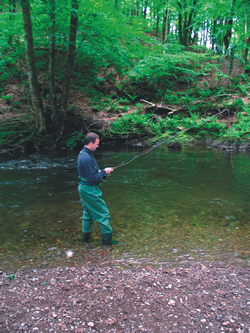
So here is my tackle selection for a session on the river in the noonday sun of summer. An AFTM 4 line in double or forward taper is about right and the rod to propel it can be 7 ft or 7 ft 6 in for the confined spaces of the small overgrown streams, or 8 ft 6 in on a big river like the Exe. For many years my choice of leader has been 5 ft of braided butt, attached to about 1 ft 6 in of 5X (.006 in) nylon, followed by 3 ft of 6X (.005 in) or 7X (.004 in) for the point. For really tough conditions it can help to go to a point of 8X.

Hatches of flies from the stream on a hot summer day are likely to be sparse but a variety of land insects will be falling on the water, and a Klinkhamer with its trailing body suggesting a waterlogged insect works well. Many fish, especially grayling and sea trout, will often be lying in deeper water and then a small goldhead or copperhead nymph will get down to the action area. You can hedge your bets, as I often do, by using the so-called New Zealand rig – tie on a bushy Klinkhamer, attach 2 ft of fine nylon to the bend of the hook with a tucked half-blood knot, and then tie a small goldhead Hare’s Ear Nymph to the other end.

Deep wading with body waders is essential on most rivers in the South West and that throws up the problem of spooking the fish with wading ripples. Such ripples can never be totally eliminated on the smoother stretches of river but a wading staff makes a huge difference in wading slowly and stealthily.

So, if you want to put your fly fishing skills to a real test, try a day on the stream in July or August and, providing the chosen river has not been devastated by extreme drought, you may get a very pleasant surprise – and a real feeling of earning your fish.

Stream Fishing in Devon

Submitted by admin on December 8, 2008 - 3:57pm

Bryan Martin, Devon Fly Fishing

Not so long ago, my river fishing was restricted to Saturday afternoons, having worked ‘up country’ from Monday to Friday. Those few precious hours were enough to completely de-stress me as everything in my head, except the job in hand, melted away. This is stress busting at its best and should really be available on the NHS.
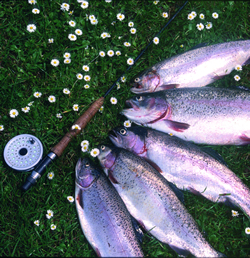
Although relaxing, concentration is essential for success. Take your time, observe everything in detail. This is no time to rush. With careful observation you will become familiar with your stretch of river and recognise the places that hold the best fish. Often these are difficult to fish. Overhanging branches, irregular currents and other obstacles conspire to prevent your fly from reaching your quarry without arousing suspicion. Over time, with experimentation, practice and a bit of luck thrown in, you will deceive your fish. If you don’t lose a few flies en route, you’re not trying hard enough.

A Limit of Twelve

Submitted by admin on December 8, 2008 - 3:57pm

Mike Weaver selects a dozen flies for trout on rivers and lakes

When the editor of Get Hooked asked me to come up with a dozen trout flies for all waters – both rivers and lakes – my reaction was something between incredulity and panic. A quick look at a couple of my fly boxes revealed dozen of patterns and I am sure that I could have produced a good reason for including every one of them. But a closer look revealed that a much smaller number showed the wear and tear of frequent use, while perhaps the majority were still in a relatively pristine state. So, perhaps the range of flies that catch most of my trout is rather narrower than the contents of the fly boxes would at first suggest.
Here then is a selection of 12 flies that season after season deliver the goods on all types of trout fisheries, starting with the rivers.

When the season opens, the streams are usually high and cold with little sign of rising trout, so it is necessary to get the fly down to the action area – and that means close to the riverbed.

Techniques for River Trouting

Submitted by admin on December 8, 2008 - 3:57pm

For the fly fisher who seeks nothing more than a sparkling stream to explore for a trout the South West is a wonderful place. Whether the moorland rivers of Dartmoor and Exmoor or the silky chalk streams of Wessex, this is a region with endless opportunities and challenges, not only for the dedicated river angler but also for many reservoir fishers who head south west for a different experience.
Sadly, however, many anglers find their first attempt at river fly fishing a frustrating experience. Branches seem to be strategically placed to snare every backcast, the fish scatter in all directions before the fly touches the water, and all the trout seem to be tiddlers. Disenchantment quickly sets in and the angler returns to other kinds of fishing that appear less demanding, and in so doing misses out on some of the most fascinating fishing available.

Wessex Salmon and Rivers Trust

Submitted by admin on December 8, 2008 - 3:57pm

Brian Marshall is the Chairman - Wessex Salmon and Rivers Trust The southern, lowland chalk streams of Wessex have a rich bio-diversity that has, for millennia, supported thriving populations of fish, flora, birds and invertebrates. Foremost among these is the famous River Hampshire Avon. Rising from the chalk aquifer of Salisbury Plain as the East and West Avon, it heads south for Salisbury where it is joined by the Rivers Bourne, Wylie, Nadder and Ebble, each offering individual characteristics and angling opportunities whilst hosting the catchment’s spawning salmon. These revered centres of trout fishing, and on the Nadder coarse angling as well, set the standard for the main river that runs from Britford through Hampshire to the sea at Christchurch in Dorset, briefly meeting with the River Stour, from the west.

Game Fishing in the South West

Submitted by admin on December 8, 2008 - 3:57pm

Wild brown trout on the moors, spring salmon in north Devon, sophisticated trout on the chalkstreams, big rainbows on famous reservoirs, night expeditions for sea trout, winter salmon in Cornwall - these are just a few of the pleasures awaiting the game fisherman in south west England.


And it is a long season too. Salmon are in season somewhere in the south west from February to 15 December, leaving a close season of little more than six weeks in the dead of winter. River fishing for trout or sea trout is available from mid March to mid October, and the growth of winter rainbow fisheries means that you can cast a fly to trout every month of the year.

SALMON

For the visiting angler, the best opportunities for salmon are on the rivers of Devon, west Somerset and, especially late in the season, Cornwall.

In the past few years, the best spring salmon fishing has been on the Taw, which produced around 250 springers in 1996, with the Torridge also offering improved early fishing. Spring is traditionally the time for spinning but the fly-only restriction on these rivers from I May, which has been in place for many years, has given anglers greater confidence in the fly, which is now in increasing use right from opening day on 1 March. North Devon's other salmon river, the East Lyn, is a prolific little fishery and can produce very good fishing immediately after floods at any time in the season, though here all of the salmon fishing is with worm or spinner.


On most salmon rivers in the south west the best of the fishing is in summer and autumn, especially when there is sufficient rain to bring in good runs of grilse. At such times good fishing will be found on the Tamar, Dart, Teign, Taw, Torridge and others. The Exe, in particular, can produce excellent catches of grilse in late summer and a recent survey indicated that angling success rates on this river were the highest for salmon in England and Wales.

Although the Cornish rivers also produce summer salmon fishing, the Camel and Fowey are noted for their autumn and winter fishing, with salmon fishing continuing until 15 December.

In the east of the region, there is also salmon fishing on the Frome and Avon, though here it is less easy for the visiting angler to get a salmon permit.

SEA TROUT

Night fishing for sea trout is a real south west speciality, and especially on the Devon rivers. Around the end of April the early big sea trout have arrived in sufficient numbers for serious night expeditions by the keener anglers and numbers continue to grow right through to late summer. As the season progresses the average weight drops, especially with the arrival of the summer school peal which are often less than a pound.

If you are looking for a really big sea trout there are few better places than the lower Dart early in the season, where fish in excess of 10lb are caught in most seasons and sea trout of 61b to 81b are relatively common. With the exception of the Ex., the main rivers of the south west all offer plenty of opportunities for a night's sea trout fishing.

TROUT

The river trout angler can choose between the silky chalk streams of Wessex and the turbulent moorland rivers of the far south west, with many variations between these two extremes. The chalk streams of the West Country may not have the international fame of the Test and Itchen to the east, yet still they provide outstanding dry fly and nymph fishing for high quality browns, and the price of a day's fishing is much more affordable. Look out for fishing on the upper Wiltshire Avon and its tributaries, or fisheries on the Frome and Piddle in Dorset.

If you are looking for wild trout in beautiful surroundings, without size being the main criterion, the bubbling streams of the Dartmoor and Exmoor National Park offer endless opportunities. The trout may be of modest size but they are numerous and often free rising. Rivers like the upper Dart, Teign, East Lyn and Barle all offer plenty of day-ticket waters at reasonable prices.

Elsewhere there are plenty more opportunities for river trouting in the south west. Something similar to chalk stream fishing can be found on the little limestone rivers of the southernmost Cotswolds, and on the meadow streams of east Devon like the Otter. It is also worth searching out little-known streams like the Bray, upper Tone, Thrushell, Ottery, Yeo and many others that can produce surprisingly good trout fishing.

The development of trout fishing on water supply reservoirs in recent decades has been well documented, but it is often overlooked that this movement really got started at Blagdon Lake in Somerset back in 1904, producing browns and rainbows of sizes that most anglers had only dreamed of before. And it was Bristol Waterworks that boosted reservoir trout fishing again with the 1957 opening of Chew Valley Lake, only three miles from Blagdon Lake. Fortunately we can still enjoy the excellent trout fishing on both of these great lakes beneath the Mendip Hills, with the addition of many more trout lakes throughout the region. Shore fishing is available on all of these reservoirs and the larger lakes offer excellent loch-style boat fishing.

More recently the growth of small-purpose-built trout pools has exploded in the south west and there can be few fly fishers who are now more than a few miles from a trout fishery. All of the usual lake techniques and flies can be used on these lakes but it is worth looking out for those which are clear enough to enjoy the exciting sport of stalking big rainbows with a weighted nymph.

TACKLE

For salmon you will need equipment for both spinning and fly fishing, the latter being particularly important on the Taw and Torridge where fly only is the rule for most of the season. A spinning rod of 9ft and medium power is about right on most rivers, and with a fixed-spool reel and 12lb to 14lb line it will also handle worm or prawn fishing where bait is permitted. In spite of its name, few anglers in the south west now use the Devon minnow, most putting more faith in the Flying C, Mepps or Rapala.

Although the more open stretches on the larger rivers are suitable for a doublehanded salmon fly rod, many anglers stick to a powerful single-handed rod of 9ft or 10ft with lines of AFTM 7 to 9 and this could easily double up as a reservoir rod. For sea trout, however, such a rod might be a bit powerful and a 9ft rod and a 6 line would be more suitable. Popular salmon flies include Willy Gunn, Ally's Shrimp and Blue Charm, while sea trout anglers favour Alexander, Silver Stoat and Mallard and Claret.

Trout fly rods are as varied as the West Country rivers. On a small overgrown river where the branches meet over the middle of the stream, a 7ft fly rod and 4 line are ideal, but when you are fishing from the bank on a larger chalk stream a rod of 8+ft or even 9ft with a 5 line will help you to keep control when reaching over bankside vegetation. If you have to compromise with one outfit, try an 8ft rod and 5 line.

Bank fishing on the larger reservoirs will demand a powerful rod of 9ft and an 8 line, but on the smaller pools I often stalk big trout with an 8ft river rod and a 5 line, so there is no easy compromise if you wish to fish all the stillwater options in the south west - even before you consider the specialist needs of loch style fishing from a boat.

Any of the vast range of popular trout flies is worth a try, but on the rivers it is always worth remembering that patterns created long ago in the West Country, like Blue Upright, Pheasant Tail, Half Stone, Tup's Indispensable, Infallible and Devonshire Doctor, still perform very effectively.

SOMETHING FOR ALL

Whatever your taste in game fishing there is something for you in the south west - just check the list of places to fish in this guide. The visitor will find a wide range of day permits from hotels, associations and fishery owners, at an equally wide range of prices. The local angler should always consider joining an association, which is often the cheapest way of fishing, especially for salmon. Some of these clubs have open membership while others will have a membership limit and a waiting list, so check with the secretaries for details. But always remember that before you go fishing you need two pieces of paper - the Environment Agency national licence and a permit from the owner of the fishery.

Pages