
Tackle

Game & Wildlife Conservation Trust " Wild Salmon Appeal "

Submitted by Mandi on July 21, 2009 - 11:35am


  Chalk Stream Research Could Unravel Atlantic Salmon Declines Globally


Atlantic salmon have suffered a massive 70 per cent decline in the past 30 years and there is now an international effort in place to provide effective conservation and restoration of the species.
For over 30 years the River Frome in Dorset, once famed for its 30lb salmon, has been providing some of the best evidence of the Atlantic salmon decline in our rivers across the country. The Game & Wildlife Conservation Trust has recently taken over one of the country‟s leading salmon and sea trout research centres based on the Frome at East Stoke (until recently, the fisheries research based on the river was run by the Centre for Ecology & Hydrology).

The Game & Wildlife Conservation Trust‟s salmon and trout research centre is directly involved in the international effort to research wild salmon declines and their causes and the entire river catchment has been transformed into an impressive natural river laboratory. To date, this research facility, which comprises the most technically advanced scientific monitoring equipment of any river in the country has collected nearly 40 years of data, which will have an important input in the future management of adult salmon.
Over that period a large amount of monitoring equipment has been installed making it the most instrumented natural river laboratory in Europe.
Despite the ongoing international conservation efforts to reduce over fishing at sea we lack the scientific evidence for managing our rivers better. We desperately need to identify which environmental conditions the fish experience in fresh water rivers best prepare them for their survival at sea. To reverse the 70% decline in returning salmon numbers over the last 20 years, and to see more 30lb salmon returning to our rivers, we urgently need to unlock these secrets.
Dr Anton Ibbotson who heads the Game & Wildlife Conservation Trust‟s research centre at East Stoke, said, “Over the last ten years we have developed specialist techniques for tagging individual fish to work alongside state-of-the-art fish counting, monitoring and tag detection equipment installed on the River Frome.“We have individually tagged 50,000 salmon parr in the last four years, which could now be distributed anywhere between the River Frome and the icy waters of Greenland. Once they start returning to the river over the next few years we will be able to monitor their arrival and help build up a picture of why some fish have survived in the sea and why others have not. This will help manage salmon populations in the future.”   

A unique feature of the catchment-based laboratory is the 'hands off' automatic electronic smolt counter which counts the delicate juvenile salmon and sea trout as they migrate to sea. The use of Passive Integrated Transmitter (PIT) tag technology enables the scientists to study large numbers of individual fish in order to better understand the factors that influence the life history, survival and migratory patterns of both salmon and sea trout. This facility is not replicated anywhere else in the UK and has far less damaging affect on the fish than using traps or other interception devices.
Dr Ibbotson explains the implications of this research, “This natural laboratory will enable us to answer many of the really important questions about salmon and sea trout stocks that would be difficult to answer elsewhere. A really good example of this is how the environmental conditions the fish experience in freshwater affects their survival in the sea. Too often, we see marine and freshwater sources of mortality as independent, but now we can follow large numbers of individual fish from their early freshwater life -stages through to maturation and spawning.”
Dr Nick Sotherton, the Trust‟s director of research, said, “This is one of the best equipped rivers for salmon and sea trout research in Europe and the research is relevant to every salmon fisherman in the country, whether he or she fishes the Spey or the Test. Working on this influential research laboratory, which has international and national standing is a considerable boost to our existing brown trout research programme and we believe it will save dramatic implications for international salmon research.”


The next stage of research for their survival

The initial conservation focus was to reduce over-fishing of salmon at sea and there is little more that can now be done. We must now focus research effort on ensuring that the freshwater habitat produces salmon that have the best chance of survival at sea. This huge natural laboratory on the River Frome is of both national and international importance – we can study, fish by fish, entire populations of migrating salmon using its unique „hands off ‟ monitoring equipment. The results will teach us how to best manage our rivers to produce more fish that will survive at sea and return to spawn.


Critical questions for the future

A great deal is known about salmon in the Atlantic - they adopt a silver coat to help evade sea predators; they must adapt internally and externally to survive the icy cold salt water; they can swim up to 100 miles a day during their 4,000 mile migration. But we know so very little about
what can be done to improve the freshwater habitat to produce salmon that have the best chance of survival on their epic journey. Is it down to the size of a salmon when it runs to sea? Is it the time of year when it chooses to migrate? Do autumn migrating fish have higher survival rates? Is it far more complicated environmental issues such as climate change, water or air temperature, river flows or rainfall patterns? Are the conditions experienced in the freshwater river affecting the number of years a salmon spends at sea? The longer at sea, the bigger the fish - every salmon fisherman wants to see more 30lb salmon in our rivers!
The River Frome and its monitoring equipment will allow us to find the answers to these questions by conducting experiments that, quite simply, could not have been done before.

Your help is crucial for wild salmon

The Trust has an enviable track record in the conservation of game and wildlife. In the coming years, this work on the River Frome will make a vital international contribution to our knowledge of the factors that affect the health of salmon populations in our rivers. The Trust would therefore like the support of anyone interesting in the conservation of salmon to fund this important research. Your support will have a direct impact on the quality of scientific input to our endeavours to increase wild salmon stocks for future generations.

Why the Trust need extra funds

  • The opportunity to save the huge data and knowledge bank waiting to be harnessed from 50,000 fish already tagged.
  • The opportunity to continue the crucial long-term monitoring research programme.
  • The opportunity of building on decades of goodwill built up with landowners adjacent to the River Frome and their huge co-operation.
  • To try and answer these questions in the future we would risk having to raise funds to build a whole new facility - many times more than the funding support required now to keep the existing site running.
  • The opportunity for the Trust‟s science to contribute to the international recovery of salmon numbers would be delayed indefinitely, a source of significant concern for game fishing enthusiasts.
  • To summarise, the opportunity to contribute to the recovery of this key game species, the king of fishes, is unprecedented and deserves to be supported.

Endorsements

Atlantic Salmon Trust “It is now vital to understand and influence conditions in our rivers and inland waterways. We are supporting the Game & Wildlife Conservation Trust because it can be entrusted to produce the science that will help rebuild thepopulation of this species.” Tony Andrews Director

Salmon & Trout Association “We thoroughly endorse and are supporting this research now being carried out by the Game & Wildlife Conservation Trust. Finding out how to reverse the alarming decline in salmon numbers will help to ensure the future for game fishing.” Paul Knight Chief Executive

TO DONATE TO THE SALMON APPEAL

Fish Legal

Submitted by Mandi on July 10, 2009 - 2:19pm


Fish Legal (previously known as the Anglers' Conservation Association, founded in 1948) was set up to protect all coastal and inland waters in the United Kingdom from pollution and other damage. Water pollution, over-abstraction and habitat damage kills hundreds of thousands of fish each year, leaving a huge impact on aquatic ecosystems and local economies, not to mention the enjoyment of all kinds of anglers. Fish Legal aims to stop this damage happening and fights for compensation for our members when it does.

We are usually fighting around 60 legal cases on behalf of our members at any one time. We make polluters pay hundreds of thousands of pounds in compensation every year and secure injunctions to stop further damage.  We can only do this with your support. If you care about the health of our rivers, seas, canals and lakes, then please support our work as an individual member. If you own or lease fishing rights of any sort, as a private individual, fishery owner or angling club, then you should join to benefit from our unique legal protection.

In England, we have entered into a partnership with Angling Trust, the new governing body for all angling and you can join Fish Legal only by joining the Angling Trust first.

If you live, or your club or fishery is based in Northern Ireland, Scotland or Wales, then you can join Fish Legal by calling 01568 620447 or visit out our website  www.fishlegal.net

Please support our work. We can only make polluters pay with your backing.

Salmon & Trout Association Westcountry Contacts

Submitted by Mandi on July 10, 2009 - 2:03pm


Game anglers influencing national decision makers over the management and protection of salmon, trout and sea trout, the conservation of water and the diverse environments upon which all aquatic life depends.

Cornwall Branch
Mr A G Hawken
Tel: 01208 75513
Email: [email protected]
North Devon Branch
Lt Col J D V Michie
Tel: 01837 871156
Email: [email protected]
South & East Devon & Tamar Branch
Mr N Reynolds
Tel: 01237 861675
Email: [email protected]
Somerset Branch
Mrs S Pizii
Tel: 01823 480 719
Email: [email protected]
Bristol & West Branch
Mr R Buckland
Tel: 01225 760465
Email: [email protected]
Hampshire Branch
Mr E P Morgan
Tel: 01730 263843
Email: [email protected]
West Sussex Branch
Mr B Burbridge
Tel: 01903 873878
Email:
[email protected]
Wessex Branch
Mr D Griffiths
Tel: 01747 871695
Email: [email protected]

Membership from just £2.50 per month!

For further S&TA information
Tel: 0207 283 5838
Email: [email protected]
Website: www.salmon-trout.org

Quick Tips from The Salmon & Trout Association

Submitted by Mandi on July 10, 2009 - 12:32pm


Whether fishing from a boat or a bank, take care you don’t leave lines and leaders behind.  They can be a danger to wildlife - as well as an eyesore!

The money from your rod licence is re-invested by the EA in caring for the waters you fish.  Always ensure you have one!

Always wear glasses when you fish to protect your eyes:  many anglers have lost their sight or had their eyes permanently damaged by mis-cast flies.

It’s a good idea to have an extra bottle of fresh water handy and a tube of sunscreen when fishing during hot summer months.

Bank etiquette ensures you and other anglers on the same stretch or beat enjoy the day.  Don’t hog a “hot spot” all afternoon;  wait until an angler has cast his line before passing -  and always pass behind him.

Are your car keys safe?  The last thing you want is for them to fall out of your pocket and into the water as you lean over to net your fish!  Make sure they are secure – a zipped pocket is ideal.

Dry fly only?  Or is nymphing allowed?  Different waters have different rules - be sure you know them before you fish.

Anglers are our waterways’ eyes and ears.   Please always report anything untoward that you see – such as antisocial behaviour  or farm animals churning the river bank.

AMI - the Anglers’ Monitoring Initiative - runs courses on how to monitor the flylife on your river.  Interested?  
More information: www.riverflies.org.

South West Rivers Association 2009

Submitted by Mandi on July 10, 2009 - 12:26pm


SWRA is the voice of riparian owners and game angling in the South West. It is the umbrella of the individual river associations in the South West and a powerful lobbying body regularly consulted by the Environment Agency and Government. Its main aim is to see salmon and sea trout stocks and the sport of angling for them return to their former glory.

As with many aspects of modern life, angling and our freedom to enjoy it are affected by an ever-growing bureaucracy. Our rivers are also subject to pressure from abstraction, pollution and public access. By enabling individual rivers to work together to speak with one voice SWRA continues to influence the political and environmental agenda in a number of key areas, including:

Salmon Stock Assessment - we lobby for a more accurate approach, a requisite of good management.
Salmon Stocking Policy - we support effective stocking to compensate for the effects of environmental degradation.
National Sea Trout and Salmon Strategy - we welcome the addition of sea trout and will campaign for effective Salmon and Sea Trout Action Plans to restore stocks to former levels.
Canoeing - we continue to support the policy of voluntary access agreements.
Abstraction - over-abstraction remains a serious threat and we are working to reverse it.
Water Framework Directive - our Secretary sits on a Panel guiding implementation of the Directive in the South West.

If you would like to know more about the work of South West Rivers Association by joining the mailing list for its Newsletter, or wish to become an individual member, please contact the Secretary, Roger Furniss at:
[email protected]

West Country Rivers Trust

Submitted by Mandi on July 10, 2009 - 12:07pm

The Westcountry Rivers Trust is an environmental charity, established in 1995 to secure the preservation, protection, development and improvement of the rivers and streams in the Westcountry, and advance the education of the public in the management of water.

The Trust was formed by a group of passionate conservationists who recognised that the integrity of our rivers and their fisheries was diminishing.  This group carefully chose a range of strategically important partners who helped develop the initial modus operandi, provided technical back-up, and promoted the importance of the Ecosystem Approach.  The partners also, importantly, helped develop a dedicated agricultural team which allowed the Trust to offer win-win solutions to long term problems, resulting in environmental gain and economic benefit for the farmer.  Over the next few years, the Trust delivered its first major project, Tamar 2000 which is still held up today as the pathfinder for what many regard as the best solution for dealing with diffuse pollution.

Since then, the Trust has evolved and moved on, though staying at all times true to its philosophy of “Think Global, Act Local”. Over the decade it has been in existence, the Trust has worked closely with over 2000 farmers and landowners across nearly 20 Westcountry catchments and has delivered many social, economic and environmental outputs including: 1400+ Integrated Land & River Management Plans; over 250 miles of river restored; 200 km+ vulnerable riverbank restored; 20+ wetlands restored; 100+ buffer zones created; 400+ sites of accelerated erosion controlled and 35 demonstration sites developed and operational.

The Trust continues to deliver strategic fisheries projects in partnership with the Environment Agency, Natural England, South West Rivers Association, AONB’s, National Parks, land managers and angling clubs and associations.  The team carry out a wide range of work including: river habitat and fish population surveys; addressing migratory barriers; instream habitat improvement such as gravel cleaning; bankside habitat restoration and protection through fencing and coppicing; and enhancing salmonid spawning and juvenile habitats in impacted river reaches. In recent years, the WRT has also been involved with a number of EU partnerships which have helped develop new and innovative approaches to address the decline in European eel, develop sustainable angling tourism management, as well as the groundbreaking Atlantic Salmon Arc Project, which developed a genetic database of salmon from Portugal to Scotland in order to improve the management of sea net fisheries for conservation of stocks and abundance.

The ‘Westcountry Angling Passport’

On the back of WRT’s early catchment restoration projects, an angling marketing initiative, called Angling 2000, was launched in order to deliver two main ambitions - the first was to provide anglers with a wide choice of reasonably priced wild fishing in fantastic Westcountry surroundings and the second was to provide farmers and riparian owners with an income to protect and enhance these watery delights.

This angling initiative has been a huge success and the Westcountry Angling Passport now builds on this success whilst expanding the range of angling opportunities in the region.  Whether you enjoy stream, river or lake fishing there is a vast choice of excellent fishing to choose from and all set within a unique and beautiful natural environment. Anglers using the Westcountry Angling Passport can also feel good in the knowledge that revenue generated through their fishing goes back into managing these rivers for the benefit of our fish stocks and future generations.

Two exciting ways to go fishing...

The Westcountry Angling Passport is operated on a ‘token’ and ‘bookable day-ticket’ basis.  The Token System is a sheer delight for the roving angler; instead of having to buy a separate ticket for each participating fishery, anglers can buy a book of tokens which gives them access to any of the fisheries, when they want and without the need to contact anyone beforehand.  Anglers simply buy a book of tokens, use the angling brochure or website to decide which of the fisheries they want to go to, and hey presto - get fishing!  

Angling tokens cost £2.50 each and come in three parts - the first part is posted in a marked letterbox located close to the fishery, at the start of the day’s fishing.  The second part is a catch return to be posted in the same letterbox at the end of the day’s fishing and the final part is the angler’s record.  The fisheries are rated according to their quality, ‘fishability’ and species of fish. Fishing costs range from 2 to 5 tokens a day (£5 to £12.50) making it extremely good value fishing!  The tokens are supplied as books of either 5 or 10 and are available for use over a fishing season.

For those wishing to try their luck at some of the finest stillwaters in the country, the angling tokens can be redeemed against a day’s fishing at the following South West Lakes Trust, trout fisheries; Kennick, Wimbleball, Siblyback, Stithians, Wistlandpound, Roadford, Colliford and Fernworthy.  Whether you enjoy bank or boat fishing, are a novice or seasoned angler, prefer stocked or wild fisheries, these lakes provide fantastic sport in some of the region’s most beautiful surroundings.

The Booking Office is an exciting development through which anglers can reserve fishing for salmon, sea trout, brown trout and grayling on some the region's finest rivers.  Anglers can use the website or information sheets to view these fisheries and bookings can be made via our ‘online service’ or by calling the office.  Once a booking has been made, the angler will automatically receive maps & directions by email or post.  We can also advise on local guides who can help you unlock the secrets to having successful day out on the river, point you in the direction of local hotels or B&B accommodation as well as providing other help and advice to make your trip as memorable an experience as possible.

If you are an angler or fishery owner who would like to know more about the Westcountry Angling Passport or would like to be a part of it, we would like to hear from you.  

Making the most out of angling for the region...

The Trust is part of a new partnership project, Collabor8, which has been awarded funding from the EU Interreg 4B North West Europe programme. WRT will be developing and expanding the Westcountry Angling Passport as a sustainable, regional, angling development and marketing scheme as well as seeking, with SW Tourism and partners, to develop clusters of angling providers and associated rural businesses in order to facilitate rural tourism. The Trust will also be working closely with a number of public and private sector organisations including the Environment Agency, South West Lakes Trust, South West Regional Devel­opment Agency and Get Hooked to maximize the success of the project and promote the region widely.

The Interreg 4B programme helps organisations from across Europe to work in partnership on common projects, learn from each other’s experiences and then put those lessons into practice. The Collabor8 project links nine initiatives from across NW Europe. The partners involved alongside WRT include Brecon Beacons National Park Authority, Merthyr Tydfil County Borough Council and South Downs Joint Committee from the UK, together with partners from Ireland, Belgium and the Netherlands.

As part of Collabor8 we will be working closely with accommodation providers, pubs, restaurants, local food producers and other rural businesses who would like to forge greater links to angling as a means of developing their businesses and increasing profitability.  So if there are any businesses who would like to discuss these opportunities please get in touch with us.
To sign up to the Westcountry Angling Passport and receive a free angling brochure detailing Token and Booking Office fisheries or to Book your day tickets / purchase Tokens please go to www.westcountryangling.com  Alternatively you can telephone or call in to the Trust office in Stoke Climsland (9am - 5pm). Angling brochures and Tokens are also available from a number of registered outlets in Devon and Cornwall (see website or brochure for details).

Contact details for the Trust:

www.wrt.org.uk
Dr Dylan Bright - Director
Westcountry Rivers Trust, Rain-Charm House, Kyl Cober Parc, Stoke Climsland, Callington, Cornwall  PL17 8PH. Tel: 01579 372140
Email: [email protected]

Contact details for the Westcountry Angling Passport:

www.westcountryangling.com
and for angling enquiries please email:
[email protected]
Toby Russell at the Westcountry Rivers Trust.
Tel: 01579 372145
Email: [email protected]


Vranch House School Charity Challenge Fishing Matches

Submitted by Mandi on July 10, 2009 - 11:21am


Vranch House School
For children with cererbral palsy & all children with physical difficulties

Fly Fishing Charity Challenges
Over £180,000 has been raised since1992.

Pairs of anglers are invited to enter the Fly Fishing Charity Challenges to raise funds for children with cerebral palsy & other physical difficulties at Vranch House School & Centre, Exeter.
Heats and semi finals take place from April to September at Bellbrook Valley, Kennick, Stithians, Tavistock, Temple and Tree Meadow.
The prize bag is £3,000. Prizes include lines, leaders, day tickets, hooks and fly tying materials. Entry is free provided the minimum sponsorship of £20 per person is raised.
Anglers who wish to enter please contact the fisheries or Sue Gould, Marketing Manager of Vranch House: Tel Exeter 01392 873543.

Contacts for fisheries:

Stithians    Redruth   
01209 821431
Kennick    Bovey Tracey
01626 206027
Bellbrook Valley    Tiverton
01398 351292
Temple    Bodmin
01208 821730
Tree Meadow    Hayle
01736 850899
Tavistock Trout    Tavistock
01822 615441

The Wheelyboat Trust

Submitted by Mandi on July 10, 2009 - 10:32am


The Wheelyboat Trust is a small national charity dedicated to providing disabled people with hassle-free access to waterborne activities such as angling, pleasure boating and nature watching.  Formed in 1985 as The Handicapped Anglers Trust, it has so far supplied 125 specially designed wheelchair accessible Wheelyboats to fisheries, water parks and other venues open to the public all over the UK.

The Trust’s principal role is to promote and provide Wheelyboats to fisheries and other venues enabling them to accommodate the needs of their disabled visitors.  We can help these venues acquire their own Wheelyboat by fundraising to discount its cost.

The features that make Wheelyboats ideal for angling also make them ideal for pleasure boating and nature watching and, consequently, the Trust is keen to meet the demand for Wheelyboats wherever it exists.  Nowadays, 50% of the Wheelyboats we supply are used for activities other than fishing and as a consequence we are making a bigger impact and benefiting larger numbers of disabled people.

The Trust’s most versatile Wheelyboat to date is the Mk III.  Its design is very straightforward and has many of the features found in its two predecessors, the most notable being the hinged bow which lowers to form a ramp.  Its shallow draught means it can be driven ashore for boarding and disembarking directly from the bank or a slipway.  The flat deck ensures its disabled users can reach all corners of the boat enabling them to helm the boat independently without having to rely on help from others.  In standard boats, wheelchair users need lifting in and out and once on board are completely reliant on a boat partner.  In a Wheelyboat, however, disabled people can do everything for themselves and are thus provided with a measure of dignity and independence not available from other craft.  
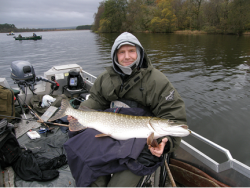
Darren Bragg, disabled angler,with a fine Pike caught from a Wheelyboat.
The Trust supplies three models at present with more on the drawing board.  We are developing a portfolio of craft suited to different activities.  Our latest models are two specialist angling boats developed in conjunction with JM Coulam Boatbuilders.  The Coulam 15 Wheelyboat is a purpose-built river fishing boat and was designed for large game rivers like the Tweed.  The Coulam 16 Wheelyboat is a larger version of the 15 and is ideal for fishing on large stillwaters where the handling, looks and performance of the standard fishing boat it is based on are important to its disabled users.  This model won the CLA Game Fair’s Most Innovative Product Award.

The South West is the busiest region in the UK for the Trust and new Wheelyboats are being launched all the time.  For the latest list of venues and for more information on the work of the Trust, visit the website or contact the Director.  The Wheelyboat Trust is a registered charity and relies upon the generosity of charitable organisations, companies and individuals to enable it to continue providing this important service on behalf of disabled people.  Donations can be made via the Trust’s website:
www.wheelyboats.org

Wheelyboats are hired like any other angling boat except that venues tend to prefer at least 24 hours notice for a booking.
THE WHEELYBOAT TRUST
Reg charity 292216

Andy Beadsley, Director
North Lodge, Burton Park, Petworth, West Sussex, GU28 0JT,
Tel/fax: 01798 342222,
e-mail [email protected]
www.wheelyboats.org

Rex Harpham, SW Regional Coordinator
22 Chollacott Close, Whitchurch Road, Tavistock, PL19 9BW
Tel: 01822 615953

Wheelyboat venues in the region...
Avon
Blagdon Lake, Blagdon 01275 332339        Trout fishing    www.bristol-water.co.uk
Chew Valley Lake, Chew Magna 01275 332339    Trout fishing    www.bristol-water.co.uk
Cornwall
Siblyback Reservoir, Liskeard 01209 860301        Trout fishing, nature watching    www.swlakestrust.org.uk
Stithians Reservoir, Redruth 01209 860301        Trout fishing, nature watching    www.swlakestrust.org.uk
Devon
Roadford Lake, Okehampton    01409 211507    Trout fishing, nature watching    www.swlakestrust.org.uk
Wistlandpound Reservoir, Barnstaple 01598 763221    Trout fishing, nature watching    www.swlakestrust.org.uk
Dorset
River Frome, Wareham 01929 550688    Coarse fishing, pleasure boating        www.warehamboathire.co.uk
Gloucs
Bushyleaze Trout Fishery, Lechlade 01367 253266    Trout fishing    www.lechladetrout.co.uk
Somerset
Clatworthy Reservoir, Taunton 01984 624658        Trout fishing    www.wessexwater.co.uk
Sutton Bingham Reservoir, Yeovil 01935 872389    Trout fishing, nature watching    www.wessexwater.co.uk
Wimbleball Reservoir, Brompton Regis 01398 371372    Trout fishing, nature watching    www.swlakestrust.org.uk

About The BDAA

Submitted by Mandi on July 9, 2009 - 3:34pm

 About The BDAA

British disabled angling association is a registered National charity founded in 1996 by former England International Terry Moseley, to offer inclusive fishing opportunities in Coarse, Sea, Game and Specimen fishing for disabled people.

 The team
A board of trustees manage the day to day running of the charity, whilst a team of trained volunteers deliver its programmes, services and events.

 Funding
The charity receives no government grants or funding, relying on the generosity of public and business donations, gifts, bequests and the revenue generated by our trading arm BDAA services. The charity welcomes any company or individual donations, financial, services, resources, products, equipment to ensure our work continues.

 Who we help
People with physical, sensory or learning disabilities of all ages, those working and supporting disabled people including,  groups, organisations, clubs, charities, families, friends, carers, businesses and schools.

Not just anglers benefit from the BDAA`s work, we also support people who want to help disabled people go fishing but have no understanding of the sport.

 Benefits of angling
Fishing offers substantial benefits for disabled people, not only as a recreational or competitive activity, but also a path to a healthier lifestyle.

Increased attention spans
Socially inclusive
Healthy activity
Therapeutic
Recreational
Educational
Competitive
Team building
Confidence building
Increased self esteem

BDAA

 How we help
BDAA provides information, support and practical advice on all issues encompassing angling for disabled people. Arranging tailored fishing events to suit any group’s needs.  
Providing an angling Buddy programme which is designed to empower volunteers using the “what to do” & “how to do it” principles of basic angling.
Access audit reports complemented by our “Access guidelines for fisheries” publication helping fisheries improve facilities for disabled people supported by the”Approved Fisheries Award scheme”.  
Delivery of a range of awareness courses designed in house to help bridge any access and social barriers within angling.

 Where next?
BDAA have a vast amount of information stored on our web site with access to details of current and past events, news, articles, adaptive fishing equipment, disabled angling clubs, membership opportunities and benefits, volunteering, partner organisations, funding advice, where to fish, award winners map, coaching and services.

www.bdaa.co.uk
Or write to:
BDAA, c/o 9 Yew Tree Road, Delves, Walsall, West Midlands, WS5 4NQ
Email: [email protected]
Telephone: 01922 860912

Newhouse Fishery, Totnes - Devon

Newhouse Fishery is tucked away in a beautiful steep valley in the heart of South Devon. The four acre lake was formed by damming the Cocks Brook, a tributary of the River Avon and Newhouse fishery is one of the best fisheries in the South West. Here at Newhouse Fishery we pride ourselves on the trout stocked in the lake.

There is always the opportunity to achieve that life long ambition – the double figure brownie or rainbow which Newhouse has a fine record for both.We have long realised the importance of tuition and this can be arranged on our beginner’s pool. Tuition is free but best to book before arriving at the fishery. This facility gives the newcomer to fly fishing the freedom to perfect the art on water specifically set aside for the purpose.Young fishermen are always welcome and tackle may be hired at minimal cost.

     Prices

Pages