
Wheelyboat Press Release December 2010
Submitted by Mandi on December 13, 2010 - 3:58pm
ENVIRONMENT AGENCY
WATER RESOURCES ACT 1991
FISH REMOVAL (ROD and LINE) BYELAWS
The Environment Agency, in exercise of powers conferred on it under section 210 of,
and paragraph 6(1)(b) of Schedule 25 to the Water Resources Act 1991 hereby makes
the following Byelaws.
Byelaw 1 Application of Byelaws
These Byelaws shall apply to the area (specified in Section 6(7) of the Environment
Act 1995) in respect of which the Agency carries out its functions relating to fisheries
except the Upper Esk.
Byelaw 2 Interpretation of Byelaws
In these Byelaws except where expressly stated or where the context otherwise
requires, all words and expressions used in these Byelaws shall have the meanings
assigned to them by the Environment Act 1995, Salmon and Freshwater Fisheries Act
1975 and the Water Resources Act 1991 except the meaning of the term “drain” is not
confined to that assigned to it by the Water Resources Act 1991
“Upper Esk” has the same meaning as assigned to it in the Scotland Act 1998 (Border
Rivers) Order 1999.
Byelaw 3 Fish Removal
(i) No person may remove by rod and line any freshwater fish listed in Schedule 1
from any river, stream or drain, or from the waters listed in either Schedule 2 or
Schedule 3 except:
(a) 15 fish, other than grayling, of not more than 20cm per day.
(b) 1 pike of not more than 65cm per day.
(c) 2 grayling of not less than 30cm and not more than 38cm per day.
The size of any fish shall be ascertained by measuring from the tip of the snout to the
fork or cleft of the tail.
Byelaw 3(i) does not apply where written permission has been given by the
Environment Agency to the owner or occupier of the fishery to dispense with any of
these requirements in relation to those fishing the owner's or occupier’s waters.
(ii) No person may remove by rod and line any freshwater fish from any stillwaters or
canals (other than those listed in Schedules 2 or 3) except with the written permission
of the owner or occupier of the fishery.
(iii) No person may remove by rod and line any eels or, subject to the provisions of
sections 9 and 28P of the Wildlife and Countryside Act 1981, shad from any waters.
Subject to the provisions of sections 9 and 28P of the Wildlife and Countryside Act
1981, Byelaw 3 shall not apply to any person who with as little injury as possible
either returns fish immediately to the same water alive or retains fish in a keepnet or
keepsack and then returns it to the same water alive on or before completion of
fishing.
Byelaw 4 Amendments and Revocations
(i) The amendments to existing Byelaws set out in Schedule 4 shall have effect
(ii) The revocations of existing Byelaws set out in Schedule 5 shall have effect.
These Byelaws come into force on 1 June 2010
SCHEDULE 1
Fish species
Species
Common name
Abramis bjoerkna
Silver bream
Abramis brama
Common bream
Barbus barbus
Barbel
Carassius carassius
Crucian carp
Cyprinus carpio
Common carp
Leuciscus cephalus
Chub
Leuciscus leuciscus
Dace
Rutilus rutilus
Roach
Scardinius erythrophthalmus
Rudd
Tinca tinca
Tench
Esox lucius
Pike
Osmerus eperlanus
Smelt
Thymallus thymallus
Grayling
Perca fluviatilis
Perch
Including hybrids between any of the above
species.
Excluding ornamental varieties or colour variants of
the above species.
SCHEDULE 2
Stillwaters
England
Lake Windermere SD39395773
Coniston Water SD3082996365
Ullswater NY450220
Derwentwater NY200260
All waters within the Broads (as defined in section 2(3) of the Norfolk and Suffolk
Broads Act 1988) subject to a close season for freshwater fish.
Wales
Llyn Tegid SH 9143 3394
Llyn Maelog SH 3253 7316
SCHEDULE 3
Canals
North East Region:-
Aire and Calder navigation between Castleford Weir and
Ferrybridge Lock.
Midlands Region:-
Stroudwater and Thames Canal.
Anglian Region:-
Fossdyke Canal.
Thames Region:-
Kennet and Avon Canal downstream of confluence with River
Kennet at Kintbury.
Lee navigation upstream of Aqueduct Lock.
SCHEDULE 4
Amendments to Existing Byelaws
Taking/Removal of freshwater fish
1. For Byelaw numbered 6 (which applies in the Yorkshire area of the former
Northumbria & Yorkshire Region of the National Rivers Authority and was
confirmed on the 26th day of October 1967) substitute:-
Byelaw 6 Limitation on the number of fish which may be taken in one
day.
No person shall kill or take away from rivers, streams, drains or canals in the
Agency’s area in any one day more than six trout (including migratory trout
except when caught by a duly authorised net).
Provided that this byelaw shall not apply to any person who takes away more
than six such fish in any one day with the previous permission in writing of
the owner or occupier of the fishery.
2. For Byelaw numbered 7 (which applies in the Yorkshire area of the former
Northumbria and Yorkshire Region of the National Rivers Authority and was
confirmed on 26th day of April 2001) substitute:-
Byelaw 7 Taking of undersized trout
No person shall kill or take away from rivers, streams, drains or canals within
the Agency’s area any fish of the kinds hereinafter mentioned of a size less
than such as is hereinafter specified, that is to say:
Trout (including migratory trout) 23 cms
The size shall be ascertained by measuring from the tip of the snout to the fork
or cleft of the tail.
Provided that this byelaw shall not apply:
(ii) Undersized trout shall not be kept in a keepnet.
3. For Byelaw numbered 7 (which applies in the Yorkshire Ouse and Hull River
Authority area of the North East Region and was confirmed on 26th day of
October 1967) is hereby amended by the substitution for the table therein of
the following table:
Taking of under-sized trout
Trout (including
migratory trout)
23 cms
4. For Byelaw numbered 17 (which applies in the North West Region and which
was confirmed on 11th day of October 1989) substitute:-
Byelaw 17 Removal of fish
No person may take or remove from any waters within the area of the
Authority without lawful authority any salmon or trout, whether alive or dead.
5. For Byelaw numbered 19 (which applies in the North West Region and which
was confirmed on 11th day of October 1989) substitute:-
Byelaw 19 Prohibition of taking undersized fish
No person shall take from any waters within the area any fish of a kind and of
a size less than such size as is hereafter prescribed, that is to say:
Migratory trout 300mm
Brown trout and char 200mm
The size shall be ascertained by measuring from the tip of the snout to the fork
or cleft of the tail.
Provided that this byelaw shall not apply to any person who takes any
undersized fish unintentionally if he at once returns to and liberates the same
in the water with as little injury as possible.
6. For Byelaw numbered 8 (which applies in the Thames Region and was
confirmed on 6th day of June 1978) substitute:-
Byelaw 8 Prohibition on taking undersized fish
Any person who removes from rivers, streams, drains or canals within the area
any fish of a kind and of a size less than such as is hereinafter prescribed, that
is to say:
Brown Trout 25cm
shall be guilty of an offence.
The size shall be ascertained by measuring from the tip of the snout to the end
of the tail fin.
7. For Byelaw numbered 9 (which applies in the Thames Region and was
confirmed on 6th day of June 1978) substitute:-
Byelaw 9 Bag limits
Any person who without the previous consent in writing of the Agency takes
or removes more than two salmon in any one day from rivers, streams, drains
or canals shall be guilty of an offence.
8. For Byelaw numbered 17 (which applies in Wessex area of the South West
Region and was confirmed on 8th day of November 1993) substitute:-
Byelaw 17. Limit on the number of fish which may be permanently
removed from the water.
B. No person shall remove permanently from any waters within the
Bristol Avon Area or the Somerset Area in any one day more than two
non-migratory trout without the written consent of the Authority.
9. For Byelaw numbered 4 (which applies in Midlands Region and was
confirmed on 28th day of March 1991) substitute:-
Byelaw 4 The taking of immature trout
No person shall take any fish of a size less than those prescribed hereunder for
the species stated from the area stated. The size of the fish shall be ascertained
by measuring the fish from the tip of the snout to the fork or cleft of the tail.
a) trout (except rainbow trout)
i) The waters of the River Severn (including its tributaries) above
or upstream of its confluence with the Afon Clywedog (SN
954847); the waters of the River Vyrnwy (including its
tributaries) above or upstream of Dolanog Weir (SJ 067127);
the waters of the River Banwy (including its tributaries) above
or upstream of its confluence with the Afon Gam (SJ 017103);
the waters of the River Tanat (including its tributaries) above or
upstream of its confluence with the River Rhaeadr (SJ 130247)
............ 15 centimetres
ii) All other waters
............. 20 centimetres
b) rainbow trout
The waters of the Rivers Derwent and Amber, including their
tributaries, which are above or up-stream of their confluence at
Ambergate, Derbyshire, (NGR SK 346 515), excluding the stretch of
the River Wye from Blackwell Mill near Buxton to Cressbrook Mill
(NGR SK 173 727) above or upstream-of Ashford-in-the-Water and
excluding any reservoir or lake-formed by the construction of a dam
across the valley of those rivers or across one of their tributaries
............ 20 centimetres
PROVIDED that this byelaw shall not apply in the case of any person who
takes any immature (undersized) fish unintentionally if he at once returns the
same to the water with as little injury as possible.
10. For Byelaw numbered 14 (which applies in Wessex area of the South West
Region and was confirmed on 8th day of November 1993) substitute:-
14. Prohibition of taking undersized trout
No person shall without the lawful authority of the Environment Agency take
from any waters any fish of any kind hereinafter listed which from the tip of
the snout to the fork or cleft of the tail is of less than the size prescribed
hereunder:
brown
trout
25 centimetres, except that the size limit on the By Brook and its
tributaries shall be 20 centimetres
migratory
trout
35 centimetres
Provided that this Byelaw shall not apply to any person who catches any
undersized trout unintentionally if he at once returns the same to the water
with as little injury as possible.
SCHEDULE 5
Revocations of Existing Byelaws
Byelaw Number
Region
Date of confirmation
Taking/removal of
freshwater fish
5. Maximum number of
fish which can be taken.
Anglian
21 April 1988
***** Crucian Carp Crusader Wins Environmental Award ****
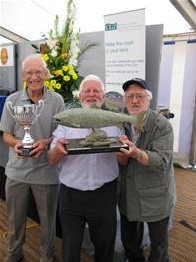
The Angling Trust and the CLA Game Fair are delighted to announce that Peter Rolfe is the winner of the first Fred J Taylor Award for Environmental Stewardship in the world of Angling. Peter is pictured with his trophy here (left), along with the Arthur Oglesby Award winner Hugh Miles (centre) and Bernard Cribbins (right). Peter was selected for his work over nearly four decades studying and conserving crucian carp, a species which has suffered a dramatic decline in numbers due to destruction of its habitat and hybridisation with feral goldfish and other carp. Peter was awarded with the Fred J Taylor Award at the CLA Game Fair on Saturday 24th July in the main theatre, along with a cash prize of £1,000 to spend on furthering his work.
In the 1970s, Peter restored, created and managed several field ponds for the benefit of crucian carp, tench and a host of other wildlife. Thousands of field ponds, once a common sight in the British countryside, have disappeared through neglect or deliberate infilling. In the 1980s, as secretary of his local angling club, Peter then moved on to creating two larger lakes of 2 and 3 acres respectively, stocked with fish which had bred in the field ponds, and restoring two half-acre lakes dating back to Saxon times. The latter he still manages as fisheries and wildlife reserves. In 1989, he set up a business raising water plants and fish, including crucian carp and tench.
He and his partners went on to create more than 20 new ponds, providing thousands of fish for stocking throughout the West Country. In the same year, he supervised restoration of two Victorian estate lakes of 2 acres each, which went on to produce fish approaching record weights. Now in his mid- seventies, Peter has just completed a book (Crock of Gold – Seeking the Crucian Carp, Mpress Ltd.) about crucian carp to pass on his knowledge to fishery managers following in his footsteps. This is the only book devoted entirely to this threatened species. Angling Trust received a small number of very high quality applications for this new award, all of which were entirely eligible to win. However Peter’s nomination stood out as being the precise embodiment of everything the Trust was trying to achieve by creating this award in memory of Fred J Taylor. Chris Yates, angling writer and star of the BBC TV series A Passion for Angling wrote in his testimonial to Peter’s work: “for several years now I have fished a pair of Saxon field ponds beautifully restored by Peter Rolfe.
Though small, these waters are now a favourite with me, not only because of their wonderful crucians and tench, but also because of their wilder inhabitants. In summer, the reedbeds are alive with damselflies and dragonflies; grass snakes bask on the banks, brook lampreys live in the feeder stream and the rare water vole lives under the banks. Last season, there was a barn owl nesting in an oak on the upper pond and I have often seen a pair of hobbies hawking for dragonflies there.” Mark Lloyd, Chief Executive of the Angling Trust said: “Peter has single-handedly contributed to the salvation of an important fish species for angling while at the same time restoring one of the country’s most threatened habitats: small ponds, along with the plethora of wildlife that are associated with them.
We are privileged that he is the first winner of this award and hope that he will inspire others. We are very grateful to everyone who took the time to apply. We will be promoting the vast amount of work carried out by the angling community to Government in discussions about how we can contribute to the Big Society agenda.” Vincent Hedley Lewis, Chairman of The CLA Game Fair Board said: “Peter is an outstanding role model who hopefully will have inspired many people to improve the water aspects of their land. Improving environmental habitat is an invaluable asset to be appreciated with grateful thanks by generations to come.” Peter Rolfe said: “Fred J Taylor’s book on tench was one of the inspirations for my field pond work in the 1970s and I feel very honoured to have won an award named after him. I am grateful to the sponsors for this opportunity to highlight the plight of the crucian carp, a fish that has been under-valued until now.
Their generosity will help me greatly in my latest project, the restoration of six derelict ponds, in two acres of marvellous wetland, where I plan to continue my research into this remarkable fish and to breed many more for waters all over the country.” Notes to Editors:
1. Fred J Taylor. Extracts from an obituary in The Times. Fred. J. Taylor, MBE, angler and writer, died on May 7, 2008, aged 89. He led a life exploring the outdoors, shooting and fishing. He was an expert chef and cooked much of the game he killed. He always had a passion for the environment in which he hunted. His first fishing piece appeared in Angling Times in 1954. He went on to write for many newspapers and magazines, among them The Daily Telegraph, the London Evening Standard, Shooting Times and Saga magazine.He produced numerous books, among them Angling in Earnest, Tench, A Guide to Ferreting, One for the Pot and Reflections of a Countryman.
2. The Fred J Taylor Award. The Angling Trust, in conjunction with The CLA Game Fair, are honouring this great man’s memory with an annual award, the first of which is awarded to Peter Rolfe. A £1,000 cash prize will initially be offered, along with a certificate and trophy. The funds should be spent on furthering the activity for which the award was given and we will invite winners to report back the following year about how the funds were helpful. Applications and nominations are requested from anyone who is, or knows someone else who is, involved in protecting or improving water habitats in England. Individuals, projects and organisations are all eligible for the award. Otherwise there are no constraints on applications. We are keen to highlight the magnificent work that anglers around the country do to clear up litter, restore damaged habitats and prevent pollution.
3. Peter Rolfe’s book, Crock of Gold – Seeking the Crucian Carp, can be obtained from Mpress 0845 408 2606 or at www.calmproductions.com.
4. List of Runners-up in alphabetical order:
Avon Roach Project: a project to reverse the decline in roach populations in the Hampshire Avon run by Trevor Harrop and Budgie Price by installing artificial spawning boards in the river and hatching the spawn in a hatchery at Ringwood. 80,000 one year old fry have been raised and released into stewponds in the past two years for release into the river.
Mr Jeff Marley was nominated by the York & District Amalgamation of Anglers, for whom Mr. Marley has been a committee member for over 24 years. He has in that time worked tirelessly as a volunteer to improve the club’s fisheries and virtually single-handedly built their Laybourne Lakes complex by de-silting a derelict pond and digging a new one. He installed platforms with disabled access around both waters and built a bridge to provide access to the island pegs.
Otterspool Angling Club, Watford was founded 20 years ago by a small group of anglers who secured a licence to fish a mile of the River Colne near Watford. In 2006, anti-social behaviour including littering, fires, poaching and vandalism on neighbouring waters threatened to see the river closed to fishing entirely. The club put a proposal to the Munden Estate to take on the additional mile and have since cleared it of all litter (including 67 black bags, a front door and a fridge) and have restored the habitat using large woody debris to secure the banks and create in-river habitat for spawning. Following a pollution incident in 2008, the club negotiated a 3 year fish stocking programme with the Environment Agency.
River Erewash Foundation: A project set up by anglers on the River Erewash, once the 2nd most polluted river in Europe, on the border between Nottinghamshire and Derbyshire. The volunteers have installed natural flow deflectors, cleaned gravels, removed rubbish (including a 3 piece suite, a mountain of shopping trolleys and a complete fitted kitchen), monitored invertebrates and has worked with local schools.
Sankey Angling Club have had the fishing rights to Dimmingsdale Reservoir, and a stretch of the adjacent Staffordshire and Worcestershire Canal in Staffordshire since the 1940s. The club has improved the environment of their waters with the help of countless volunteers aged from 7 to 75. Work has included rescuing fish from the canal in a pollution incident, management of water vegetation, installation of 30 bird and bat boxes, maintaining fish stocks, introducing 40 metres of floating island fish havens, removal of mink.
5. Contact Angling Trust, Eastwood House, 6 Rainbow Street, Leominster, Herefordshire, HR6 8DQ. 0844 7700616 www.anglingtrust.net [email protected] Out of hours press enquiries: Mark Lloyd 07973 468198

*Press Release* Press Release* Press Release* Press Release*
Toft Newton Trout Fishery wins 2010 Alan Faulkner Memorial Award
On behalf of The Wheelyboat Trust, veteran actor and passionate angler Bernard Cribbins presented Jason Foster of Toft Newton Trout Fishery with this year’s Alan Faulkner Memorial Award. The presentation took place on Friday, 23rd July at the CLA Game Fair, held this year at Ragley Hall. The main prize was a 4hp outboard motor provided by the award’s sponsors, Suzuki Marine.
Created in memory of the Trust’s Founder President, the award is presented annually to the game fishery that provides disabled anglers with the most outstanding service, facilities, opportunities and access. Previous winners include Eyebrook Trout Fishery, Tweed Foundation, Grafham Water and Lake of Menteith. Toft Newton Trout Fishery is a small reservoir in the heart of rural Lincolnshire and is well established as Lincolnshire’s number one trout fishing venue.
The 40 acre reservoir provides excellent sport for all trout anglers from beginners to expert. It is a concrete bowl and consequently has its limitations in terms of access for disabled anglers but gets round this by operating one of the original Mk I Wheelyboats to run alongside its fleet of standard boats. However, what impressed the judges the most was the attitude and determination of Jason Foster, the fishery’s owner, to ensure that disabled anglers can get on the water and fish.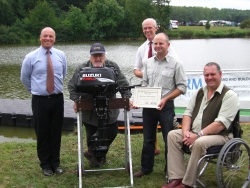
The service he offers is exemplary. While bank access is limited for wheelchair users, the fishing lodge, loos and parking are all accessible, essential requirements for a hassle-free day’s fishing in their Wheelyboat. As well as being a fitting memorial to The Wheelyboat Trust’s Founder President who conceived the idea of the wheelchair accessible boat, the ‘Wheelyboat’, the award is intended to highlight the needs of disabled anglers and encourage fisheries to ensure those needs are accommodated. The Trust is delighted that Suzuki Marine sponsored the award again this year with the main prize of a 4hp 4-stroke outboard. Without their support and appreciation of the award’s aims, it would not be the sought after title it has now become.
The Suzuki small outboard range, from 4 to 15 horsepower, has attracted a strong following amongst anglers, due to the quiet running, low emissions and 4-stroke fuel economy. In common with the rest of the 2hp to 300hp range, they offer excellent value for money. Background The Wheelyboat Trust is a registered charity that promotes and provides the wheelchair accessible Wheelyboat to fisheries and other waters open to the public all over the UK. It has now supplied 136 Wheelyboats since the Trust began work in 1985. It offers four different types of Wheelyboat to suit different activities - two of these have been designed specifically for fishing.
This is the seventh year that Suzuki Marine has sponsored the Alan Faulkner Memorial Award. The Wheelyboat Trust (reg charity no 292216) - Andy Beadsley - Director North Lodge
Burton Park
Petworth
West Sussex
GU28 0JT Telephone: 01798 342222
Mbl: 07860 650023
email: [email protected]
www.wheelyboats.org
****** South West Fishing For Life ******
South West Fishing For Life is delighted to announce the start of another group on a Kennick lake in Devon thanks to SWLakes Trust. The days at Kennick are the 2nd Sunday of the month starting at 2pm and finishing with a delicious tea provided by our lovely volunteers.
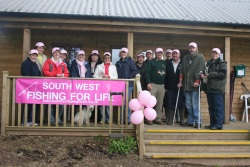
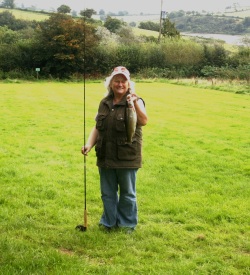
All our sessions at the lakes are free to people who have suffering or recovered from breast cancer, thanks to donations, fund raising events and grants and the generosity of SWLakes Trust. We are now planning another club on a lake in Cornwall for next year. Please look at www.southwestfishingforlife.org.uk to read all about us and to see forth coming fund raising events or contact us. We look forward to hearing from you.
Enquiries Please Contact:
Gillian 01398 371244 Email: [email protected]
Chris Hall Email: [email protected]
******** For immediate release Monday 26 July 2010 *********
Legal Loophole Lets Poachers off the Hook
The Angling Trust has learnt that DEFRA and the Environment Agency (EA) last year accidentally abolished the law which created an offence of fishing in the close season. This will lead to poachers and illegal anglers caught in this spring’s coarse fishing close season getting away with lesser offences when their cases go to court. The EA has now proposed an emergency byelaw to correct the error. The announcement was tucked away behind an announcement about new byelaws relating to eels, presumably in the hope that no-one would notice. A single bullet point on the last page of a seven page document quietly proposes to: “create the offence for fishing during close seasons and close times” to correct this mistake. The eel byelaws are printed in full, but the close season byelaw is only provided on the Agency web site at http://www.environment-agency.gov.uk/homeandleisure/recreation/fishing/1...
The Marine & Coastal Access Act repealed Section 19 of the Salmon and Freshwater Fisheries Act. This was with the intention of allowing the Agency to regulate and enforce close seasons/close times entirely by byelaw. However, the repeal overlooked the fact that S.19 also contained the only offence of fishing during the close season and close times. Government lawyers had assumed the offence was included in national/regional byelaws, but these simply set out close season dates/times and do not include offences. As a result, while all the existing close seasons and times remain as set out in byelaws, there is now no active offence of fishing during the close season or close times.
The Angling Trust understands that 14 anglers have been successfully prosecuted for fishing in the close season and that their convictions will now have to be nullified. Over 90 other cases are pending. Prosecutions of Section 19 offences will have to be halted, but some offenders will be prosecuted for other offences (e.g. fishing without a licence or byelaw contravention).
In addition, Section 35 (subsection 2) of the Salmon and Freshwater Fisheries Act (1975) allows holders of a rod licence to require another angler to show his licence and give his name and address. Failure to produce a licence was an offence. This was a very useful tool for angling clubs and fisheries, in particular for fishery and club bailiffs or water-keepers. However, Section 220 (subsection 8) of the Marine and Coastal Access Act (2009) removed this authority, limiting it to Environment Agency enforcement officers and police officers only, by amending the Salmon and Freshwater Fisheries Act to omit Section 35, Subsection 2.
Angling Trust will be seeking a reinstatement of this provision. In the meantime the Trust is issuing guidance to its member clubs about how to address this unwelcome change, which we are told is because the old legislation might raise issues regarding data protection requirements and the protection of young people. Mark Lloyd, Chief Executive of the Angling Trust and Fish Legal said: “We are very concerned that such a major error could be made by the teams of lawyers involved in drafting new legislation. We also believe that the attempts to conceal the error were misconceived and that a full public statement should have been made once the error was discovered. The Trust will remain vigilant in ensuring that law-abiding anglers’ interests are protected, and that clubs and fisheries have the tools available to help police their fisheries.”
****** For immediate release Wednesday 14 July 2010 *********
Anglers Demand Action As Rivers Dry Up
Thousands of angling clubs, fishery owners and anglers are witnessing low river flows and water levels, which are threatening vital invertebrate life in rivers and fish stocks. Angling Trust is calling on the Government, the Environment Agency and water companies to address the issue by developing long term sustainable management strategies for water resources. Angling Trust and its legal arm Fish Legal have had reports from their members of problems on many rivers including the Eamont in the North West, the Teme in the West Midlands, the Usk in South Wales and the Teign in Devon. Most of the problems are caused by abstraction of water continuing as normal, in spite of the lowest spring and summer rainfall in a generation. The situation has even seen a hosepipe ban introduced in the North West, which is traditionally one of the wettest areas of the country. Low flows impact severely on the ecology of rivers and make them much more vulnerable to pollution because there is less dilution of pollutants and warm water holds less oxygen.
The reduced wetted area means that there is less space for invertebrates to live in, and therefore less food for fish. The Trust is also demanding that the new Government takes on board the recommendations contained in the Blueprint for Water, which was developed by the Angling Trust’s predecessors and 15 other organisations nearly four years ago.
The Blueprint set out a detailed strategy for tackling low flows and addressing water wastage: In summary:
• Reduce total consumption of water by 20% and from 180 litres per day per person to European average levels of 125 litres per day through education and metering.
• Tackle leakage in water company supply pipes.
• Introduce mandatory water efficiency standards in existing homes.
• Make all new-build homes water neutral in areas where water is scarce; developers would have to ensure that new water usage is offset by investment in efficiencies elsewhere.
• Amend or revoke damaging abstraction licences which damage river wildlife.
• Set out a plan for installing water meters in every home by 2020 to deter excessive use, with tariffs to protect vulnerable customers.
• Restore wetlands and halt development on floodplains to allow water to soak into the ground rather than disappear out to sea.
These measures would not only protect wildlife in our rivers, but they would also ensure security of supply for our growing population and reduce the significant energy use and carbon footprint involved in providing water. Mark Lloyd, Chief Executive of the Angling Trust and Fish Legal said: “our members are fed up with seeing wildlife in the rivers they fish suffering as a result of a failure by Government, OFWAT, the Environment Agency and the Water Companies to develop coherent plans to reduce water use and wastage in the context of climate change and population growth. Rivers are vitally important for a whole host of wildlife and millions of anglers”.
For More information:
Tel: 0844 7700616
Media enquiries: Mark Lloyd, 07973 468198
CALLS FOR PROTECTION OF FISH STOCKS GROW LOUDER AS POPULARITY OF SEA ANGLING SOARS
Sea angling is a fast growing pastime in England and Wales with 1.9 million men, women and children over 12 taking part last year.
In a report out this week, the Environment Agency says this is a rise of 26 per cent since the Government’s Drew Report in 2003 when the figure was 1.5 million including children under 12.
In the past two years 2.8 million people over 12 said they had been sea fishing.
John Amery, chairman of the marine committee of the Angling Trust, the governing and representative body for all angling, said the sharp increase would mean that the number of full-time jobs directly generated by sea angling would have risen substantially above the 19,000 in the 2003 survey.
“Sea angling continues to increase its contribution to the coastal economies of England and Wales at a rather faster pace than we had expected. It has become a vital part of the much larger tourist industry and is of particular benefit to coastal economies outside the peak tourist months, as anglers fish through the winter.”
The Trust would, he said, continue to lobby ministers and every MP and MEP with a coastal constituency to support measures to improve the sport, particularly by restoring declining fish stocks.
“In particular we want the government to ensure sea angling is fairly represented on the ten new inshore fisheries and conservation authorities which will begin operating next year and not lumped in together with commercial fishing.
“The aspirations of commercial fishing have often been over-emphasised at the expense of recreational sea angling and the substantial economic, environmental and social benefits which it alone brings.”
The report shows that even more people, 3.3 million, went freshwater angling last year of whom 940,000 or 28 per cent also went sea fishing.
The social profile of the sea anglers had an AB C-1 bias with 56 per cent in those groups. Freshwater anglers were more evenly spread in terms of social group.
A quarter of sea anglers live in the South East and East Anglia while 18 per cent reside in the East and West Midlands. This latter figure supports the assertion that many anglers travel to the coast to practice their sport, bringing revenue to coastal communities.
The Environment Agency concludes that overall, attitudes to both sea and freshwater angling remain generally positive, and in some aspects more positive than in 2005.
Higher levels of agreement were recorded for “angling is an acceptable pastime”, “anglers care for the environment” and “angling fits in well with other activities such as walking and cycling”. Lower levels of agreement were recorded for “angling is a cruel pastime”.
Young people (12-16 year olds) are more likely to have positive rather than negative perceptions of angling, however they are likely to be less positive overall than adults. Perceptions of angling as an “OK thing to do” had increased since 2005.


